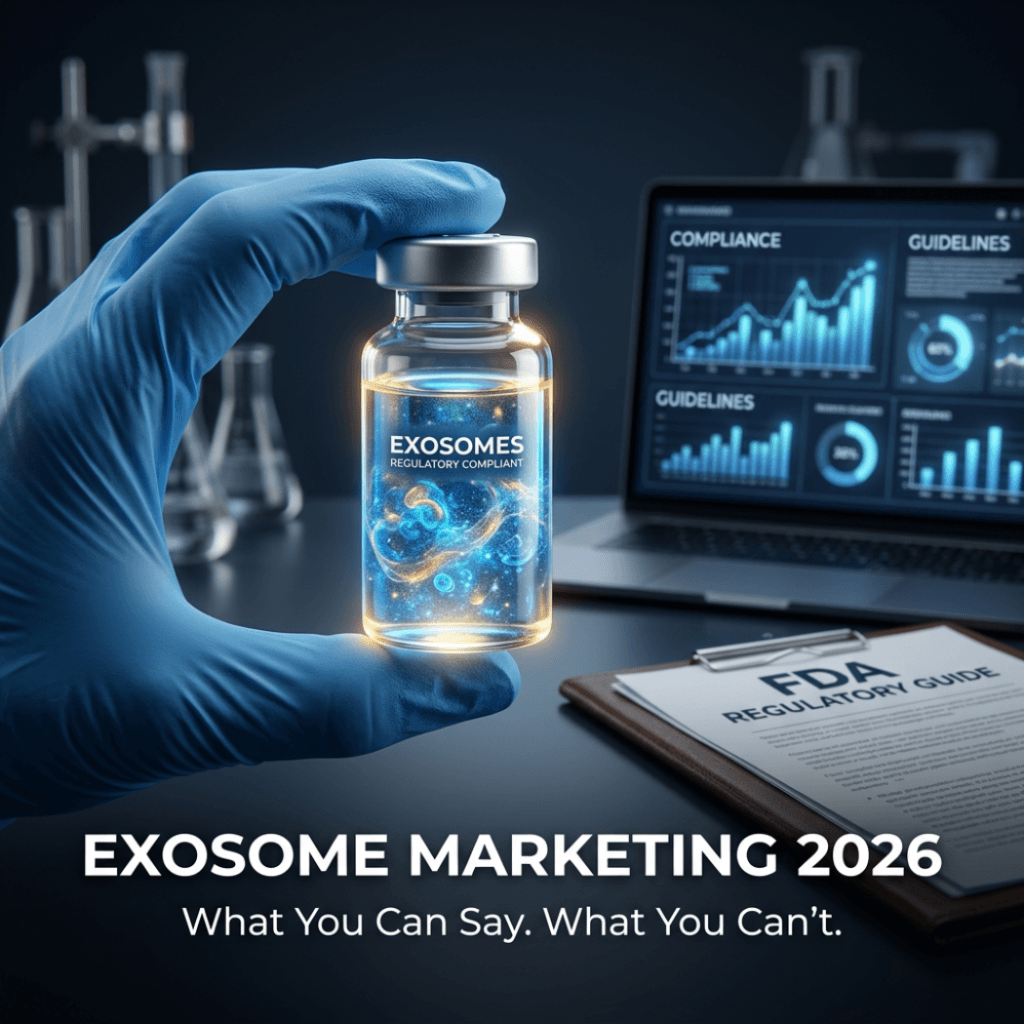
Exosomes are one of the most searched topics in regenerative medicine right now, and one of the most dangerous things a clinic can market. As of 2026, the FDA has issued more than 12 warning letters specifically targeting exosome product marketing. The FTC has permanently banned clinic operators from ever marketing stem cell and exosome treatments again. And yet clinic websites across the country still have “book your exosome treatment” buttons live right now. This article is for the clinic owners who want to stay out of that statistic.
TLDR: There are zero FDA-approved exosome products for human therapeutic use as of 2026. Not for joints, not for hair, not for anti-aging, not for neurological conditions. The FDA has issued 12+ warning letters targeting exosome marketing. Injectable exosomes are regulated as 351 biologics requiring full FDA approval that no clinic currently holds. Topical cosmetic exosome serums are a different category but still cannot make therapeutic claims. Clinics can educate about exosome biology. They cannot offer exosome therapy. This guide covers the zero-approval reality, the enforcement actions, the injectable vs. topical distinction, and exactly what compliant exosome-related content looks like.
Important Note
This article is for educational purposes only and does not constitute legal, medical, or regulatory advice. Marketing strategies discussed should be reviewed by qualified legal counsel before implementation, particularly regarding FDA, FTC, and state-specific advertising regulations. Regen Portal is a marketing company, not a law firm or compliance consultancy.
I need to be direct with you on this one. If your website currently markets exosome therapy as an available treatment, you are operating in the highest-risk marketing category in all of regenerative medicine. This is not compliance paranoia. This is the modality where the FDA has been most aggressive, most consistent, and most public about enforcement.
After 15 years in this industry, I have watched the enforcement pattern play out the same way every time. A product rep tells a clinic their exosomes are “FDA-compliant.” The clinic adds exosomes to their service page. They write a few Instagram posts about the benefits. Six months later, they get a warning letter, and suddenly the rep is nowhere to be found.
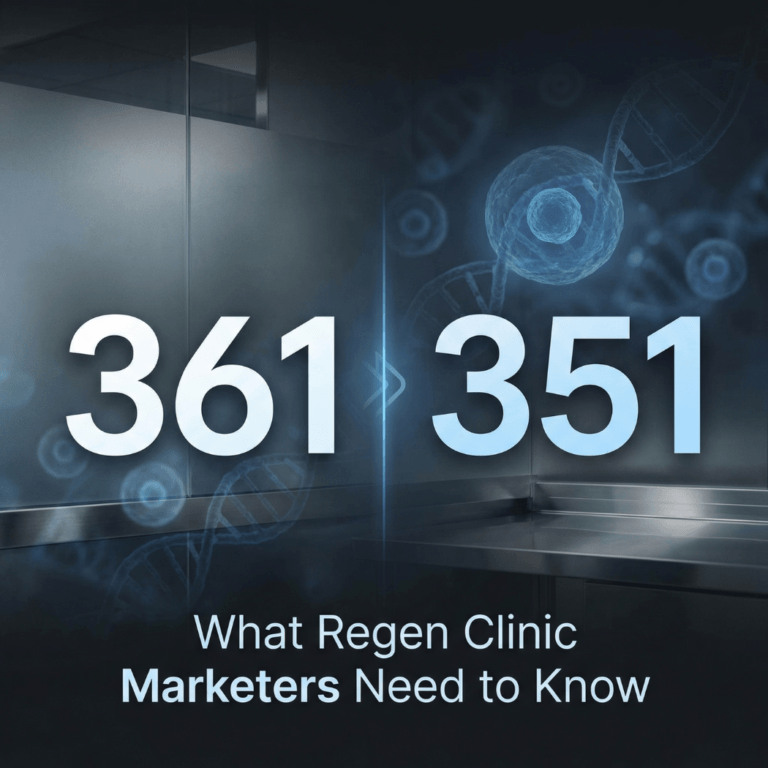
We covered FDA warning letters for regenerative medicine clinics, the traffic light framework for compliant marketing language, and the 361 vs. 351 regulatory framework in previous guides. This article applies all of those frameworks specifically to exosomes, the modality that needs them most.
The Zero-Approval Reality
This needs to be stated clearly and without qualification: there are no FDA-approved exosome products for human therapeutic use in the United States as of 2026.
Not for joint pain. Not for hair restoration. Not for anti-aging. Not for neurological conditions. Not for aesthetics. Not for immune support. Not for any therapeutic indication at all.
Exosomes used therapeutically in humans are regulated as biologics under Section 351 of the Public Health Service Act and the Federal Food, Drug, and Cosmetic Act. This means they require either a full Biologics License Application (BLA) or, for clinical investigational use, an active Investigational New Drug (IND) application. No clinic in the United States currently holds either for an exosome product they are administering commercially.
The FDA’s Public Safety Notification on Exosome Products states this explicitly. The FDA issued this notification because patients were being harmed by unapproved exosome products, and clinics were marketing them as if they were approved treatments.
According to Unicorn Bioscience, the zero-approval status has not changed since the FDA’s original 2019 notification. As of January 2026, no exosome product has received BLA approval, and no clinic-administered exosome product is operating under an active IND for commercial therapeutic use.
What this means for your practice: No claim from a manufacturer, distributor, or sales representative changes this status. “FDA-compliant” does not mean “FDA-approved.” Zero approved products means zero legal basis for marketing exosome therapy to patients. Period.
What the FDA Has Actually Done: Warning Letters and the Escalation Pattern
The FDA’s enforcement against exosome marketing follows a clear and accelerating timeline.
In 2019, the FDA issued its first public safety notification on exosome products after patients were hospitalized from contaminated exosome injections. The agency placed the industry on notice. The enforcement discretion period for regenerative medicine products ended on May 31, 2021. Since then, the FDA has moved from warnings to active enforcement.
As of October 2025, the FDA has issued more than 12 warning letters specifically targeting companies marketing exosome products. These include Chara Biologics (January 2025), Evolutionary Biologics (whose products EXO RNA, EVO JEL, and EVO HYBRID were flagged for unapproved drug and biologic marketing claims), and New Life Medical Services (September 2025, which cited both website and Instagram content).
The Evolutionary Biologics case is particularly instructive for clinic marketers. The FDA flagged their products specifically because of marketing claims on their website, including phrases like “regenerative effect through growth factors,” “stimulate neuron growth,” and “treat neurodegenerative diseases.” The FDA did not need to inspect their manufacturing facility to issue the warning letter. They read the website. That was the evidence.
In January 2025, the FTC permanently banned the co-founders of the Stem Cell Institute of America from marketing stem cell treatments and ordered them to pay more than $51 million. Their marketing included testimonials with unapproved treatment claims. The FTC enforcement pattern applies equally to exosome marketing claims.
What this means for your practice: Enforcement is active, accelerating, and marketing language is the primary evidence the FDA uses. If your website currently markets exosomes as a treatment, the question is not whether the FDA will notice. It is when.
What Your Product Rep Means When They Say “FDA-Compliant”
This is one of the most common sources of confusion for clinic owners. A sales representative tells you their exosome product is “FDA-compliant,” “FDA-registered,” or “FDA-cleared.” You hear “approved.” But that is not what those words mean.
“FDA-registered” means the manufacturing facility has registered with the FDA. It does not mean the product is approved for therapeutic use. Every tissue establishment that processes HCT/Ps must register under 21 CFR Part 1271. Registration is a paperwork requirement, not an approval.
“FDA-compliant” typically means the manufacturing process follows current Good Manufacturing Practice (cGMP) or HCT/P regulations. According to BioRegenEx, this means the facility meets baseline manufacturing standards. It does not mean the product has been evaluated, tested, or approved by the FDA for any therapeutic indication.
“FDA-cleared” is a specific term that applies to medical devices that have received 510(k) clearance. No exosome product has received 510(k) clearance for therapeutic use.
None of these phrases changes the zero-approval status. A product manufactured in an FDA-registered facility using compliant processes is still an unapproved biologic if it is marketed for therapeutic use. The manufacturing quality does not create marketing permission.
What this means for your practice: When a product rep tells you their exosomes are “FDA-compliant,” ask them one question: “Does this product have a Biologics License Application or an active IND?” If the answer is no (and it will be), then it cannot be legally marketed as a treatment, regardless of the manufacturing quality.
Injectable vs. Topical: Two Very Different Exosome Categories
Most exosome marketing guides miss an important distinction. Not all exosome products carry the same regulatory weight.
Injectable and systemic exosome products are firmly in 351 biologic territory. These are products injected into joints, administered intravenously, or delivered through any route intended to have a systemic therapeutic effect. No approved products exist. No therapeutic marketing is permitted. This is the category where the FDA has concentrated its enforcement.
Topical cosmetic exosome biologics are a different category. Serums applied to the skin surface after aesthetic procedures like microneedling are regulated as cosmetics, not drugs, if they make no drug claims. According to the Stem Nova Network, topical exosome serums used for cosmetic purposes (skin conditioning, hydration, surface-level appearance improvement) operate in a different regulatory lane than injectable exosomes.
However, and this is critical: topical exosome products that make any disease or therapeutic claims immediately cross from cosmetics into drug territory. “Repairs cellular damage,” “reverses aging at the cellular level,” or “stimulates tissue regeneration” are all drug claims, even for a topical product. The moment the marketing implies the product changes the structure or function of the body beyond surface-level cosmetic effects, it is regulated as a drug.
A clinic offering a topical exosome serum post-microneedling is in a genuinely different regulatory position than one offering IV or injectable exosomes. But the marketing compliance rules apply to both. Topical does not mean unregulated. It means differently regulated.
What this means for your practice: If your clinic uses topical exosome serums for cosmetic purposes, your marketing must stay within cosmetic framing (skin appearance, hydration, surface conditioning). If your clinic uses injectable exosomes for any purpose, there is currently no compliant way to market them as a treatment.
What Clinics Can Say: The Education-Only Framework
Clinics can educate. They cannot offer. Here is exactly what compliant exosome-related content looks like.
“Exosomes are small vesicles involved in cell-to-cell communication.” This is a biological fact. It describes what exosomes are without making any therapeutic claim.
“There are currently no FDA-approved exosome products for therapeutic use in the United States.” This is the most important sentence to include on any exosome-related page. It establishes regulatory transparency.
“Research into exosome biology is ongoing. Clinical applications are being studied in controlled trials.” This is yellow-light language that works when paired with the zero-approval disclosure and a research citation with appropriate caveats.
“If you are interested in learning more about regenerative medicine options that may be appropriate for you, schedule a consultation.” This consultation CTA is tied to a general inquiry, not to exosome therapy specifically.
Here is what must never appear in your marketing. Any variation of “exosome therapy available” (treatment offer for an unapproved product). “Exosomes accelerate healing” or “exosomes regenerate tissue” (efficacy claims for an unapproved product). “Our exosomes are sourced from FDA-registered labs” framed to imply approval. “Book your exosome treatment” (commercial CTA for an unapproved product).
The distinction is simple: you can describe what exosomes are biologically. You can state their regulatory status. You can point people to research with appropriate framing. You cannot offer them as a service, imply they have therapeutic benefits, or create any CTA that connects exosomes to a treatment booking.
What This Means for Your Website, Social Media, and Patient Conversations
Here is how to apply the education-only framework across your marketing channels.
Website. Service pages should not list exosomes as a service with a booking CTA. If you want an educational page about exosome biology, it must include the zero-approval disclosure prominently, use only biological description language, and link to a general consultation page rather than an exosome-specific booking form. Your content creation strategy should treat exosome content as education, not service marketing.
Social media. No “exosome therapy now available” posts. No before-and-after content attributed to exosome treatments. No testimonials about exosome outcomes. Educational posts about exosome biology with the zero-approval disclosure are compliant. Posts that imply availability or efficacy are not.
Google Ads. Exosomes fall squarely under Google’s Speculative and Experimental Treatment policy. Do not attempt to run Google Ads for exosome services. Even educational landing pages about exosomes may trigger disapprovals due to the subject matter. Focus your paid advertising budget on compliant consultation-based campaigns and organic SEO.
Patient conversations. In-office clinical discussions are outside the scope of marketing rules, but scope-of-practice and off-label use regulations still apply. Check your state laws. Marketing rules govern what you say publicly. Clinical judgment governs what you discuss privately with patients.
If you currently have non-compliant exosome content live: Audit your website, social media, and Google Business Profile today. Remove any content that offers exosome therapy as a service, implies efficacy, or creates a treatment booking pathway for exosomes. Replace with compliant educational content using the framework above. Then consult qualified legal counsel to review your full marketing program.
The Business Angle: Why Playing It Straight Protects Your Practice
The clinics marketing exosomes aggressively right now are operating on borrowed time. FDA enforcement is accelerating. Warning letters are public record and indexed by Google. Platform bans are permanent.
The clinics that educate responsibly, build trust through transparency, and position themselves as the credible option in a gray-market category are the ones that will still be standing in five years. Patients increasingly research exosome products themselves. According to the peer-reviewed literature (PMC), there is an urgent need for clearer regulation of exosome products precisely because patients are being exposed to unsubstantiated marketing claims.
When a patient finds that your clinic aligns with the FDA’s own guidance, that builds more trust than any “exosome therapy available” headline ever could. Compliance is not a limitation on your marketing. It is a positioning advantage.
Frequently Asked Questions
Are Exosome Treatments Legal in the United States?
The treatments themselves exist in a regulatory gray area. But the marketing of exosome products as treatments for any therapeutic indication is clearly prohibited because no FDA-approved exosome products exist. Clinics operating under physician discretion may have clinical arguments, but the marketing must reflect the zero-approval status.
Can I Market Exosome Services on My Clinic Website?
No. You cannot market exosome therapy as an available service. You can publish educational content about exosome biology with the zero-approval disclosure prominently displayed. The page must not include a treatment booking CTA tied to exosomes.
What Has the FDA Done to Clinics Marketing Exosomes?
The FDA has issued 12+ warning letters targeting exosome product companies and clinics since the enforcement discretion period ended in 2021. Warning letters have cited website and social media content as evidence. The FTC has permanently banned operators from marketing and ordered millions in penalties.
What Is the Difference Between Injectable and Topical Exosomes?
Injectable exosomes are regulated as 351 biologics requiring full FDA approval. No approved products exist. Topical cosmetic exosome serums applied to the skin surface are regulated as cosmetics if they make no drug claims. But any topical product that claims to repair damage, reverse aging, or regenerate tissue crosses into drug territory.
My Product Rep Says Their Exosomes Are “FDA-Compliant.” What Does That Mean?
It means the manufacturing facility likely follows cGMP or HCT/P registration requirements. It does not mean the product is approved for therapeutic use. Ask whether the product has a BLA or active IND. If no, it cannot be marketed as a treatment.
If I Only Offer Topical Exosome Serums, Do the Same Rules Apply?
The topical cosmetic category has more marketing flexibility, but only within cosmetic framing: skin appearance, hydration, surface conditioning. The moment your marketing implies therapeutic effects (tissue regeneration, cellular repair, anti-aging at a biological level), the product crosses into drug territory and the same prohibitions apply.
What Can I Actually Say About Exosomes in My Marketing?
Describe exosome biology (“small vesicles involved in cell communication”). State the regulatory status (“no FDA-approved products for therapeutic use”). Reference ongoing research with appropriate caveats. Link to a general consultation page. Do not offer exosomes as a treatment, imply efficacy, or create a booking pathway tied to exosome therapy.
For more on navigating compliance in regenerative medicine marketing, subscribe to Oscar’s YouTube channel for weekly insights from industry leaders: https://www.youtube.com/@oatellez
Key Takeaways
- Zero FDA-approved exosome products exist for therapeutic use. This is the foundational fact that governs all exosome marketing. No manufacturer claim changes this status.
- The FDA has issued 12+ warning letters targeting exosome marketing. Enforcement is active, accelerating, and uses website and social media content as primary evidence.
- “FDA-registered” and “FDA-compliant” do not mean FDA-approved. These terms describe manufacturing standards, not product approval. Do not let a sales rep’s language become your marketing language.
- Injectable and topical exosomes are different regulatory categories. Injectable exosomes are 351 biologics with no approval. Topical cosmetic serums have more flexibility but cannot make drug claims.
- Clinics can educate. They cannot offer. Biological descriptions, zero-approval disclosures, and research framing with caveats are compliant. Treatment offers, efficacy claims, and booking CTAs tied to exosomes are not.
- Compliance is a competitive advantage. The clinics marketing exosomes aggressively now are the ones that will face enforcement later. The ones that educate responsibly are building trust that lasts.
Navigating Exosome Marketing Is Complex, But Not Impossible
The goal is to educate without offering, and that requires content strategy built by people who understand both the science and the rules. Regen Portal’s full services are built specifically for the regenerative medicine industry.
If you want help building compliant marketing that positions your practice as the credible option in a complex regulatory landscape, let’s talk.
Email: [email protected] YouTube: Subscribe for weekly insights
About Regen Portal
Regen Portal is a marketing company serving the regenerative medicine industry. We provide SEO, content creation, social media management, paid advertising, website development, and branding services for clinics, manufacturers, distributors, and independent providers. Some strategies discussed in our educational content align with services we offer. For more information, contact us.
Oscar Tellez is the founder of Regen Portal, a marketing company built for the regenerative medicine industry. With over 15 years of experience spanning clinical operations, product distribution, and digital marketing, Oscar has helped hundreds of practices, manufacturers, and distributors grow through compliant, high-performance marketing strategies. He holds a B.S. in Exercise Physiology and Health Promotion from Florida Atlantic University.