
Most regen clinic owners have spent years dealing with the same problem: every paid advertising channel they would naturally use is restricted. Google Ads blocks stem cell, PRP, and exosome campaigns under its experimental treatments policy. Meta restricts health and wellness ads. Programmatic display carries its own content rules. What most clinic owners have not fully recognized is that there is a channel where none of those paid ad restrictions apply to organic content, and it is the second-largest search engine in the world.
TLDR: YouTube organic content is governed by YouTube’s Community Guidelines, not by Google’s Ads policy. A clinic that cannot run a paid Google or YouTube ad for stem cell therapy can publish a YouTube video on that exact topic, optimize it for search, and have it drive consultation inquiries for years. YouTube is the second-largest search engine in the world. Patients increasingly watch on smart TVs in their living rooms. A well-built channel produces compounding patient acquisition over 12 to 24 months. The compliance rules that apply to written marketing still apply to video scripts: citation amplification cuts both ways.
Important Note
This article is for educational purposes only and does not constitute legal, medical, or regulatory advice. Marketing strategies discussed should be reviewed by qualified legal counsel before implementation, particularly regarding FDA, FTC, and state-specific advertising regulations. Regen Portal is a marketing and consulting company, not a law firm.
YouTube organic is the channel most regen clinics know exists, most do not use, and most consistently underestimate. The asymmetry between paid and organic on this platform is the premise of this guide. It rests on a precise legal and technical distinction between Google’s advertising policies and YouTube’s content policies, and that distinction is worth understanding before building a channel around it.
Why YouTube Is Different for Regen Clinics
The paid-versus-organic distinction is the core technical claim of this entire article, so the precision matters.
YouTube paid advertising (pre-roll ads, in-feed ads, shorts ads, masthead placements) runs through Google Ads and is governed by Google’s advertising policy on speculative and experimental medical treatments. Under that policy, in effect globally since October 2019, paid ads for stem cell therapy, PRP, exosomes, and most other regenerative procedures are not allowed. The restriction is not selective. It applies regardless of credential, license, or framing. A board-certified physician at a fully licensed clinic cannot run a paid Google or YouTube ad promoting a stem cell consultation. That door is closed.
YouTube organic content (videos that a clinic uploads to its own channel without paying for promotion) is governed by YouTube’s Community Guidelines, a completely separate policy set. The Community Guidelines regulate harmful content, misinformation, hate speech, and harassment. They do not prohibit educational medical content from licensed practitioners. YouTube also recognizes an Educational, Documentary, Scientific, or Artistic (EDSA) exception for content that would otherwise touch sensitive topics, but regen clinic educational content does not need to rely on EDSA to be eligible for publication: it simply does not violate the guidelines in the first place. A clinic owner can publish a 15-minute video explaining what a PRP consultation involves, what regenerative medicine research currently looks at, or how to choose a qualified provider, and that video is eligible to be found by anyone searching YouTube.
The practical result: YouTube organic is a fully open content channel for the exact subject matter that paid advertising blocks. This is the only major search-driven channel where the paid restriction and the organic permission diverge this clearly. It is the strongest reason a regen clinic should be on YouTube in 2026.
For a full picture of what regen clinics can and cannot do with Google paid search, the paid-channel rules are covered separately. This article focuses on what the organic side opens up.
Why YouTube Works for Patient Acquisition
YouTube is the second-largest search engine in the world after Google, processing billions of searches monthly. Pew Research has tracked the same behavior for more than a decade: searching online for health information remains one of the most common internet activities, and an increasing share of that research is happening on YouTube specifically.
Patients searching “what is PRP therapy,” “how does stem cell treatment work for joints,” or “what should I expect at a regenerative medicine consultation” are finding answers on YouTube, either from the clinic’s own channel or from someone else’s. The clinic with the video earns the attention. The clinic without one has no presence in that part of the research journey.
The television factor in 2026 changes the math. YouTube viewing on smart TVs and connected TVs has overtaken phone-based viewing for long-form content. Patients are in their living rooms in the evening, watching chosen content on a large screen in a relaxed state. A regen clinic provider who appears on that screen, speaking clearly about their training and clinical approach, occupies a level of patient attention that no website page or social post can match.
YouTube videos are also long-duration assets. A Google ad stops the moment the budget stops. A YouTube video ranks and drives traffic for years with no ongoing spend after production.
The Content That Actually Books Consultations
Views are not the metric. Consultation inquiries are. Some content drives them; some does not.
Content that converts to consultations:
- “What to Expect at a Regenerative Medicine Consultation”: addresses first-contact hesitation directly
- “PRP versus Surgery: Questions to Ask Your Doctor”: positions the provider as a resource, not a salesperson
- “How We Evaluate Patients for Regenerative Therapies”: shows clinical rigor
- “What the Research Says About PRP for [Specific Application]”: educational credibility
- “Who Is a Good Candidate for Stem Cell Therapy?”: pre-qualifies patients before the consultation
- Provider introduction video: who the doctor is, what they believe about patient care, why they practice regenerative medicine
Content that builds authority over time:
- “Regenerative Medicine Explained”: awareness content for early-research patients
- “PRP, Stem Cells, and Exosomes: What Is the Difference?”: comparison content for educational searchers
- “How to Choose a Regenerative Medicine Provider”: decision-framework content that positions the clinic favorably
Content that does not convert:
- Generic “what is PRP” videos with no clinical depth that patients can find with higher production quality elsewhere
- Videos that lack a clear call to action (book a consultation, call the office, visit the website)
- Padded content that fills runtime without substantive information
YouTube SEO for Medical Practices
Title. Include the primary keyword and a patient-facing benefit. “PRP Therapy Consultation: What Every Patient Should Know” outperforms “About Our PRP Program.” The title is the strongest individual ranking signal in YouTube search.
Description. Aim for 300 to 500 words minimum. Open with a 2 to 3 sentence summary. Include primary and secondary keywords naturally. Include the clinic’s name, city, and contact information. Link to the website and booking page.
Tags. Use 10 to 15 tags combining primary keywords, secondary keywords, location terms, and provider credentials. Location-specific tags drive local patient searches.
Thumbnail. Custom thumbnail showing the provider or recognizable clinical setting. Professional but human. Thumbnails drive click-through rate, a primary ranking signal.
Video length. Healthcare YouTube research suggests how-to videos perform best around 8 minutes; educational videos around 17 minutes. Benchmarks from published research, not official YouTube specs. Substantive content that fills its length outperforms padded content.
Chapters and timestamps. Chapter markers improve watch time and create additional searchable surface area, since YouTube indexes chapters separately.
YouTube and Google Search: The Double-Ranking Opportunity
Because YouTube is owned by Google, well-optimized YouTube videos appear directly in Google Search results for relevant queries. A video optimized for “regenerative medicine consultation what to expect” can rank in both YouTube search and Google Search, effectively doubling the clinic’s organic search presence for that query without producing separate content.
As AI Overviews continue to expand in healthcare search (71% coverage on health queries as of Q1 2026), YouTube transcripts are increasingly drawn into AI-generated answers. A video transcript that clearly and accurately describes what regenerative medicine involves becomes a candidate source for AI Overview citations.
Embedding the video in the clinic’s website pages compounds the effect. It improves time on site and behavioral signals for the page, which strengthens the page’s broader organic SEO strategy that YouTube content feeds into. The embedded view also feeds the video’s own watch time, which strengthens its YouTube ranking.
What Production Actually Requires
A regen clinic YouTube channel does not require a production team or studio.
Camera. A current-generation smartphone shoots 4K. Sufficient for a medical practice channel.
Lighting. A basic ring light or softbox costs $50 to $150 and eliminates the flat look of office overhead lighting. Lighting matters more than camera.
Audio. A clip-on lavalier microphone ($20 to $80) produces dramatically better audio than the built-in mic from any distance. Audio is what loses viewers fastest when it is bad.
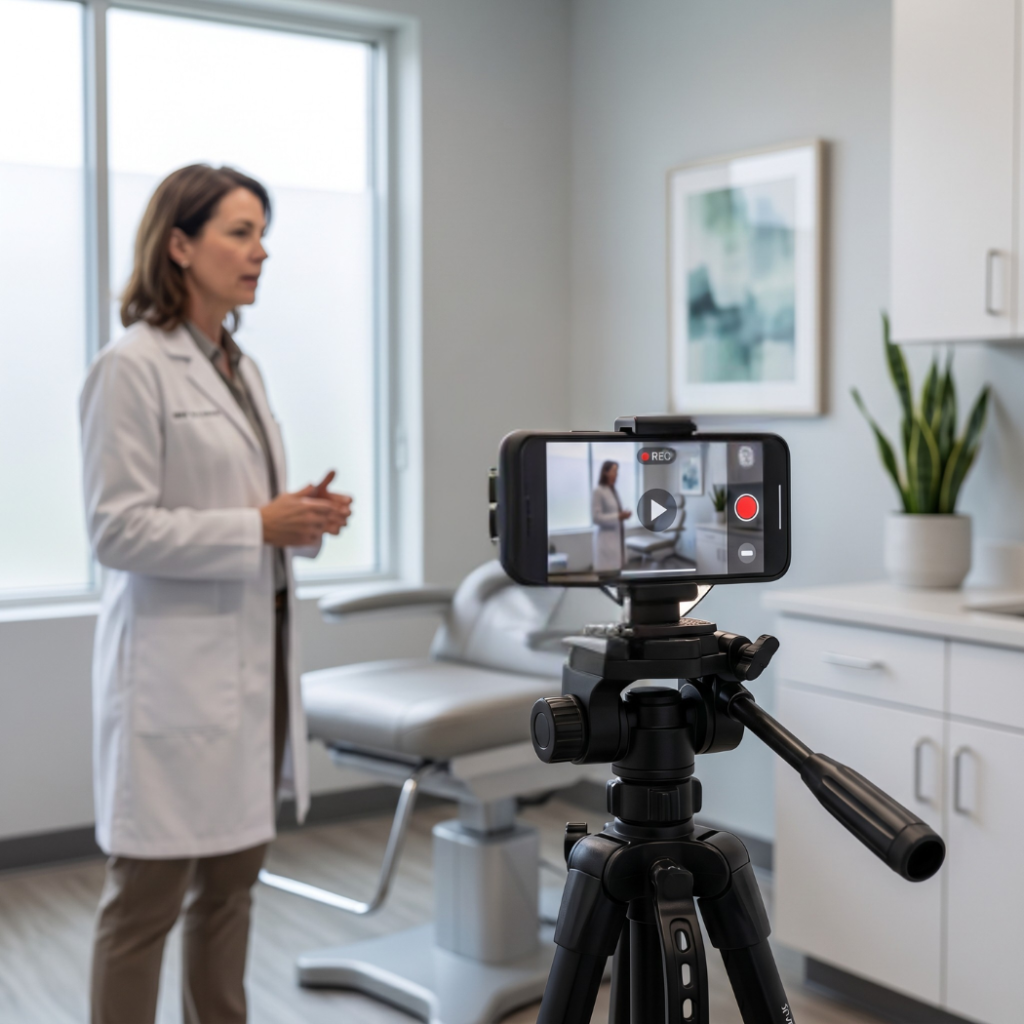
Background. A clean clinical environment (exam room, consultation office, or branded clinic space). Generic backgrounds remove the credibility signal.
Editing. Basic trim, cut, and lower-third text for the provider name and credentials. Free and low-cost tools handle this comfortably.
Consistency. One video per week produces meaningful growth. Two per month produces slower but measurable results. Inconsistency is the single most common reason medical practice channels fail.
The Compliance Layer for Video Content
YouTube organic content is not subject to Google Ads policy restrictions, but it is fully subject to FDA and FTC standards. The same compliant marketing language standards every regen clinic needs to respect apply to spoken claims in a video script. A claim spoken on camera is as actionable under FDA and FTC enforcement as the same claim in writing. Marketing risk extends to every channel a clinic publishes on.
Specifically for video: do not make disease-specific outcome claims for unapproved procedures. Patient testimonial videos describing specific clinical outcomes carry the same FTC endorsement risk as written testimonials. Before-and-after video content carries particular exposure. Consult qualified legal counsel before publishing clinical claims in video format. Citation amplification cuts both ways. A compliant educational video can earn AI Overview citations and compound consultation flow. A non-compliant video amplifies exposure to a far larger audience than the same words on an unread blog post.
Setting Up the Channel
A short operational checklist for the launch:
- Channel name matches the practice name, not a generic term
- Channel art and icon use the professional logo and a branded header
- About section covers who the practice is, what it does, where it is located, with contact information and natural keyword usage
- Channel trailer: a 60 to 90 second introduction video explaining who the provider is and what viewers will find on the channel
- Playlists organize videos by topic: “PRP Explained,” “Stem Cell Therapy,” “What to Expect,” “Provider Introductions”
- Website link and booking link in the channel About section and in every video description
- Consistent posting schedule announced in the channel trailer and maintained
- YouTube Health Certification: YouTube offers a health certification program for licensed medical professionals that grants access to a provider credential panel beneath videos and elevated placement in health-related search results. Worth pursuing as part of channel setup for any licensed regen provider building a channel under their own name.
What Realistic Results Look Like
Clinics that have built consistent educational YouTube channels typically report meaningful consultation flow within 6 to 12 months and compounding inquiries over 12 to 24 months. The channel functions as a long-duration patient acquisition asset that continues generating contacts after the initial production work is done.
The curve is not linear. Early videos accumulate views slowly and then compound as the channel builds watch-time history and authority. Clinic owners who treat YouTube as a 90-day experiment and abandon it do not see results. Clinic owners who treat it as a 12 to 24 month asset-building program consistently do.
The asymmetry worth repeating: a Google ad runs only while the budget runs. A well-produced educational video generates patient contacts in year three from the same content that generated them in year one.
Frequently Asked Questions
Does YouTube have the same advertising restrictions as Google Ads for stem cell and PRP?
Paid YouTube ads are subject to the same Google Ads experimental-treatments policy as Google Search ads. Organic YouTube content (videos uploaded to a clinic’s channel without paid promotion) is governed by YouTube’s Community Guidelines, which do not prohibit educational medical content from licensed practitioners. The paid and organic paths are different policies.
What video topics actually drive consultation bookings?
Consultation-focused content: what to expect at a consultation, how the clinic evaluates candidates, questions patients should ask their doctor, and provider introduction videos. Authority-building content (what is PRP, comparison of regenerative therapies) supports long-term traffic but converts more slowly.
How long should regen clinic YouTube videos be?
Healthcare YouTube research suggests how-to and procedural videos perform best around 8 minutes; educational videos around 17 minutes. These are benchmarks, not algorithm rules. Substantive content that fills its length performs better than padded content at any length.
What equipment do I actually need?
A current-generation smartphone, a $50 to $150 ring light or softbox, a $20 to $80 lavalier microphone, and a clean clinical background. Free or low-cost editing tools handle basic trim and lower-thirds. Production complexity is not what drives results in medical-practice YouTube.
Do the same compliance rules apply to video as to written content?
Yes. FDA and FTC standards apply identically. A spoken claim on camera carries the same enforcement risk as a written claim in an ad. Patient testimonial videos and before-and-after content carry particular exposure under FTC endorsement guidance.
How do YouTube videos feed into Google Search and AI Overviews?
YouTube videos appear directly in Google Search results for relevant queries because YouTube is owned by Google. Video transcripts are also drawn into AI Overviews on health-related queries. A single well-optimized video can earn presence across YouTube search, Google Search, and AI-generated answer surfaces.
How long until a YouTube channel produces real patient inquiries?
Typically 6 to 12 months for the first meaningful consultation flow, with compounding growth across 12 to 24 months. Clinics that treat the channel as a short-term experiment rarely see results. Clinics that treat it as an asset-building program consistently do.
Key Takeaways
- YouTube organic content is governed by Community Guidelines, not by Google’s experimental-treatments ad policy. Paid YouTube ads are still restricted; organic videos are not.
- YouTube is the second-largest search engine in the world. Patients researching regenerative medicine search YouTube heavily, including on smart TVs in their living rooms.
- Consultation-conversion content (what to expect, how candidates are evaluated, provider intros) outperforms generic explainer content.
- Healthcare YouTube videos perform best around 8 minutes for how-to content and 17 minutes for educational content per published research benchmarks, not algorithm rules.
- Production quality matters less than audio quality and content depth. A smartphone with good lighting and a lavalier microphone is sufficient.
- FDA and FTC standards apply identically to video scripts. Spoken claims carry the same enforcement risk as written claims.
- Realistic results: 6 to 12 months to first meaningful consultation flow, compounding across 12 to 24 months.
Ready to Build a YouTube Channel That Actually Books Patients?
YouTube is the open channel in a restricted-channel industry. It compounds. It is also the channel most regen clinics know they should build and have not started yet. Production is not the obstacle. Consistency and content strategy are.
PS: If you want help structuring a YouTube channel, scripting a content calendar, or integrating video into the clinic’s broader content strategy, reach out.
Email: hello@regenportal.com
Subscribe on YouTube: https://www.youtube.com/@oatellez
About Regen Portal
Regen Portal is a marketing company built for the regenerative medicine industry. We work with clinics, manufacturers, distributors, and independent providers on SEO, content, paid advertising, social media, website development, and branding. Some of the strategies covered in this article overlap with services we offer. For more on me and my team, contact us.
About the Author
Oscar Tellez is the founder of Regen Portal, a marketing and consulting company built for the regenerative medicine industry. He has been in this industry since 2015. He started in medical sales and has worked with PRP since 2016. He has reached hundreds of practices and over 200 doctors through sales, teaching and marketing. He holds a B.S. in Exercise Science and Health Promotion from Florida Atlantic University.