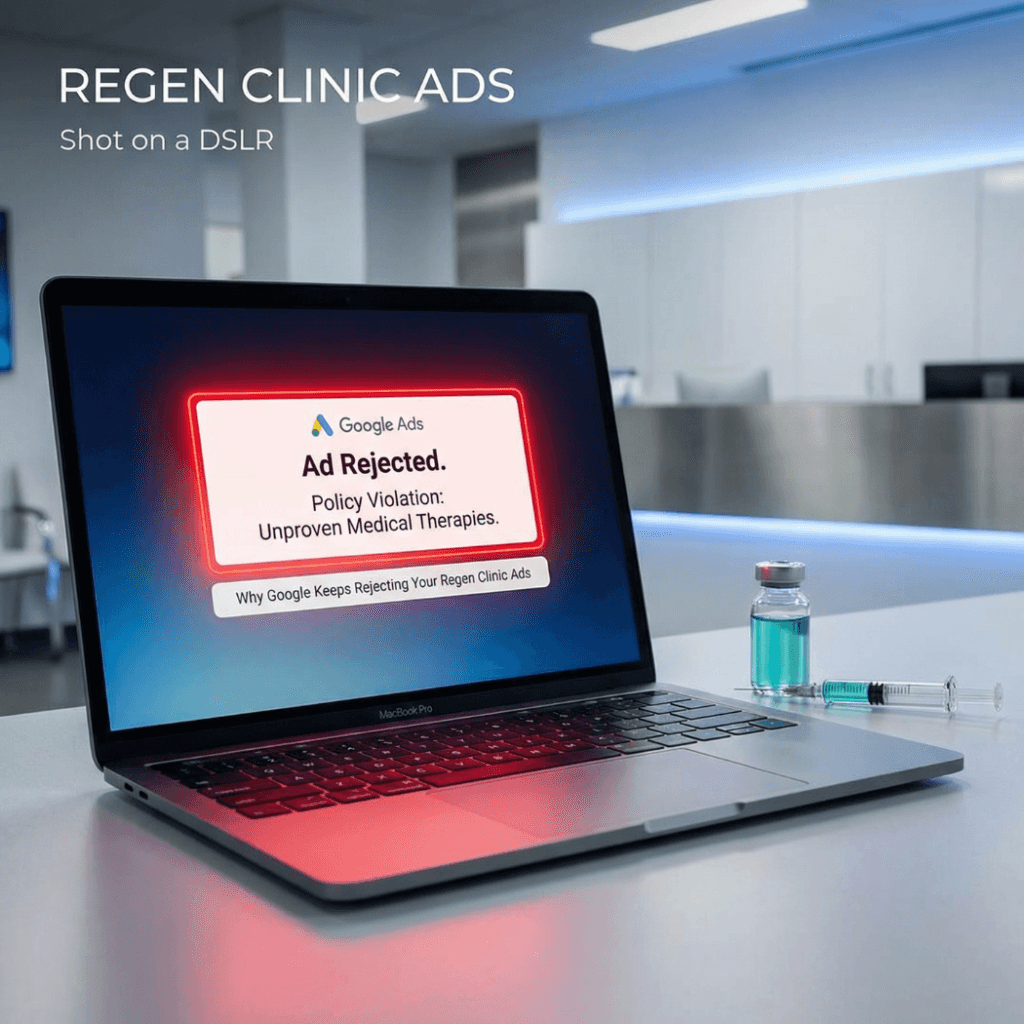
Approximately 58% of first-time healthcare ads are disapproved on initial submission, the highest rejection rate of any advertising vertical on Google. For regenerative medicine clinics, that number is effectively higher because Google’s “Speculative and Experimental Treatment” policy specifically names PRP, stem cell therapy, cellular therapies, and regenerative medicine. Most clinic owners spend weeks troubleshooting ad copy, changing words, and swapping headlines, only to get the same rejection over and over. That is because they are fixing the wrong thing. This article tells you exactly what Google is actually looking at, how to diagnose which policy you are hitting, and how to build a compliant advertising strategy that does not end in an account suspension.
TLDR: Google’s automated review system scans three layers: your ad copy, your landing page, and your account history. Most regen clinic owners only fix the ad copy and keep getting rejected because their landing page still contains speculative treatment language. The “Speculative and Experimental Treatment” policy specifically bans promotion of PRP, stem cells, and regenerative medicine as treatments. But educational content ads, consultation-focused copy, and practice brand campaigns are all allowed. This guide covers the four violation types, the three-layer scan, compliant ad examples, the appeal process, and when to pivot your budget to SEO instead.
Important Note
This article is for educational purposes only and does not constitute legal, medical, or regulatory advice. Marketing strategies discussed should be reviewed by qualified legal counsel before implementation, particularly regarding FDA, FTC, and state-specific advertising regulations. Regen Portal is a marketing company, not a law firm or compliance consultancy.
I have watched clinic owners burn through thousands of dollars trying to crack a code that does not exist. They rewrite the headline. They swap “PRP therapy” for “platelet treatment.” They try new keywords. Every variation gets disapproved. Then they get frustrated and give up on Google Ads entirely. Or worse, they create a new account to start fresh, which triggers a permanent ban on both accounts.
The problem is not your copywriting skills. The problem is a specific policy that most clinic owners have never read, combined with a review system that scans far more than just your ad text. Once you understand how both work, you can either build a compliant campaign or make the strategic decision to redirect your budget to channels that work better for regen clinics. We covered the PRP-specific angle in our guide on writing PRP ad copy that does not get banned. This article covers the full picture.
The Policy Behind the Rejection
Google’s Speculative and Experimental Medical Treatment policy prohibits the promotion of “speculative and/or experimental medical treatments.” The policy specifically names stem cell therapy, cellular (non-stem) therapy, gene therapy, regenerative medicine, platelet-rich plasma (PRP), and biohacking.
This is not a judgment about clinical validity. It is a categorical policy based on regulatory approval status. Google does not evaluate whether PRP works. Google evaluates whether the treatment has full regulatory approval for the indication being advertised. Most regen modalities do not.
The critical word in the policy is “promotion.” Google draws a line between promoting a treatment (banned) and providing educational or informational content about a treatment (permitted under specific conditions). The distinction matters: an ad that says “PRP hair restoration, book now” is promotion. An ad that says “Learn about options for hair thinning, schedule a consultation” is informational.
Understanding this distinction is the foundation of every compliant Google Ads campaign for a regen clinic.
The Three-Layer Scan: How Google Actually Reviews Your Ads
Most clinic owners think Google only looks at their ad copy. That is wrong. Google’s automated review runs a three-layer scan.
Layer 1: Ad copy. Google scans your headlines, descriptions, and display URL for flagged terms. “PRP therapy,” “stem cell treatment,” “regenerative healing,” and similar phrases trigger the speculative treatment filter.
Layer 2: Landing page. Google scans the full page your ad points to. Every paragraph, heading, image alt text, and testimonial on that page is reviewed. A clean ad pointing to a landing page that says “PRP regenerates hair follicles” or “stem cells heal your joints” will be disapproved just as fast as a non-compliant ad.
Layer 3: Account history. Prior violations escalate the review threshold. An account with a clean history gets more benefit of the doubt than one with multiple prior disapprovals. This is why a “clean new campaign” in an account with prior violations gets flagged faster than the same campaign in a brand-new account.
According to SagaPixel, Google also runs “substantiation matching,” checking whether your landing page supports the claims your ad makes. If your ad says “learn about PRP” but your landing page says “book your PRP treatment for hair regrowth,” the mismatch triggers additional red flags.
What this means for your practice: Fixing your ad copy without fixing your landing page is like repainting the front door while the house is on fire. Both layers must be compliant. And if your account has a history of violations, you need a thorough cleanup before any new campaign will run without issues.
Diagnosis: Which of the Four Violation Types Are You Hitting?
Here is a practical diagnostic framework. The four most common violation types for regen clinics, with symptoms and fixes.
Violation 1: Speculative and experimental treatment promotion. You are directly advertising PRP, stem cells, exosomes, or regenerative therapy as a treatment. The fix: remove all treatment promotion language from both the ad and the landing page. Pivot to educational and consultation framing.
Violation 2: Missing healthcare provider certification. Some healthcare services require Google Healthcare Certification before you can advertise them. The fix: apply for certification with a valid medical license. This is a separate process from the speculative treatment policy.
Violation 3: Misleading claims on the landing page. Your ad copy is clean, but your landing page says things like “PRP restores hair naturally” or “regenerative therapy relieves joint pain.” The fix: audit and rewrite the entire landing page, not just the ad. Your content creation strategy must align with your ad strategy.
Violation 4: Account-level suspension from repeat violations. You have had multiple disapprovals and Google has flagged the entire account. The fix: this requires a formal appeal with full compliance documentation. It is not a quick fix, and it requires patience and thoroughness.
| Symptom | Likely Violation | First Step |
|---|---|---|
| Ad disapproved with “speculative treatment” cited | Violation 1 | Remove treatment language from ad AND landing page |
| Ad disapproved with “healthcare certification” cited | Violation 2 | Apply for Google Healthcare Certification |
| Ad copy looks clean but still getting rejected | Violation 3 | Audit the landing page for hidden treatment claims |
| All new ads disapproved immediately, even clean ones | Violation 4 | Full account audit + formal appeal required |
What Regen Clinics Can Advertise on Google
Despite the restrictions, there is a compliant Google Ads strategy for regen clinics. Here is what works.
Educational content ads. Drive traffic to blog posts or educational pages about what PRP is, what regenerative medicine involves, or how to choose a clinic. The ad promotes the content, not the treatment. Example: “What Is Regenerative Medicine? Read Our Patient Education Guide.”
General consultation ads. Invite patients to explore their options with a specialist. No modality named, no treatment promised. Example: “Joint Health Consultation With a Regenerative Medicine Specialist. Schedule Today.”
Practice brand ads. Advertise the clinic’s expertise, credentials, and approach without tying it to a specific therapy. Example: “Board-Certified Regenerative Medicine Physician. 15 Years of Experience. Learn More.”
Non-regen services. If your clinic also offers FDA-approved services (certain laser treatments, wellness consultations, approved injectables), those can be advertised directly under standard healthcare ad rules.
Here are common non-compliant examples that will get flagged.
“PRP hair restoration, book your appointment today.” This is direct treatment promotion for an off-label use.
“Stem cell therapy available. Reverse aging naturally.” This names a speculative treatment and makes an outcome claim.
“Regenerative therapy for joint pain relief.” This promotes regenerative therapy as a treatment for a condition.
“Exosome treatments now available at our clinic.” This markets an unapproved product as an available service.
The pattern is consistent across every compliant example: sell the consultation, sell the education, sell the expertise. Never sell the treatment in the ad.
How to Appeal a Disapproval the Right Way
If your ad has been disapproved, the official appeal process is your path forward. But how you appeal matters as much as whether you appeal.
Do not appeal before fixing the underlying issue. Appeals submitted without actual changes are almost always rejected, and repeated failed appeals increase account-level scrutiny. Google tracks your appeal history.
The right sequence is: identify the specific policy cited in the disapproval notice, audit and fix both the ad copy and the landing page, then submit the appeal with a clear and specific explanation of what was changed and why it now complies.
A generic appeal like “I believe my ad is compliant” fails. A specific appeal like “I have removed all references to PRP therapy from both the ad headline and the landing page. The ad now promotes an educational blog post about joint health with a general consultation CTA. The landing page contains no treatment claims” has a much higher success rate.
If your first appeal is rejected, refine and resubmit with additional detail. You can appeal multiple times, but each submission should include new information or changes.
Account Suspension: When It Gets Serious
A disapproved ad is fixable. An account-level suspension is a different situation entirely.
Account suspensions happen after repeated policy violations, multiple denied appeals, or attempts to circumvent the system. The Google Ads account suspension overview covers the official process.
The most critical warning for regen clinic owners: do not create a new Google Ads account to get around a suspension. Google’s circumvention policy explicitly bans this. Creating a new account results in permanent suspension of both the original and the new account. There is no workaround for this. The only path back is through the appeal process on your original account.
If your account is suspended, the appeal process is more formal. You may need to provide documentation showing compliance changes across all landing pages, remove all flagged content before submitting, and work through Google’s support team directly. This can take weeks.
What this means for your practice: Prevention is far easier than recovery. Building compliance into your paid advertising strategy from the start avoids the escalation cascade entirely.
When to Stop Fighting Google Ads and Invest in SEO Instead
Here is the honest conclusion that most paid advertising guides will not give you: for most regenerative medicine clinics, Google Ads is a high-effort, low-return channel because so much of what you offer is off-limits for promotion.
The clinics that grow consistently in regenerative medicine are the ones building organic authority through SEO: compliant blog content, Google Business Profile optimization, local SEO, and educational service pages. These assets compound over time and are not subject to daily policy enforcement. A blog post ranking for “What is PRP therapy” generates patient inquiries for years without a single ad dollar and without any risk of account suspension.
Google Ads for regen clinics are best used for the narrow slice of allowed content: educational campaigns, consultation-focused ads, and non-regen services your practice offers. For everything else, organic is both more sustainable and more compliant.
We covered the traffic light framework for compliant marketing language in a previous guide. That framework applies equally to your ad copy, your landing pages, and your organic content. The rules do not change by channel. Only the enforcement mechanism does.
Frequently Asked Questions
Why Does Google Keep Rejecting My Ads Even When My Copy Looks Clean?
Google scans three layers: ad copy, landing page, and account history. If your ad copy is clean but your landing page contains treatment claims for speculative therapies, the ad will still be disapproved. Audit the landing page, not just the ad.
What Exactly Is “Speculative and Experimental Treatment” in Google’s Policy?
It refers to treatments that lack full regulatory approval for the advertised indication. Google specifically names stem cell therapy, cellular therapy, gene therapy, regenerative medicine, PRP, and biohacking. The policy bans promotion of these treatments but permits educational and informational content about them.
Is It My Ad Copy or My Landing Page Causing the Problem?
It could be either or both. Google reviews all three layers (ad, landing page, account history). The most common pattern for regen clinics is clean ad copy pointing to a non-compliant landing page. Fix the landing page first.
Can I Appeal a Google Ads Disapproval and Win?
Yes, if you fix the issue before appealing. Generic appeals fail. Specific appeals that explain exactly what was changed and why it now complies have a much higher success rate. Do not appeal without making actual changes first.
What Types of Ads Can a Regen Clinic Run Without Getting Flagged?
Educational content ads, general consultation ads, practice brand campaigns, and ads for FDA-approved non-regen services all work within Google’s rules. The key: promote education and consultations, not treatments.
What Should I Do if My Google Ads Account Is Already Suspended?
Audit every landing page tied to the account. Remove all non-compliant content. Submit a detailed appeal explaining specific changes. Do not create a new account. Google treats this as circumvention and permanently bans both accounts.
If Google Ads Are Mostly Off-Limits, Where Should I Spend My Marketing Budget?
Organic SEO is the most sustainable patient acquisition channel for regen clinics. Educational blog content, Google Business Profile optimization, and compliant service pages drive patient inquiries without ad platform risk and compound over time.
For more on building a compliant advertising and SEO strategy for regenerative medicine, subscribe to Oscar’s YouTube channel for weekly insights from industry leaders: https://www.youtube.com/@oatellez
Key Takeaways
- Google scans three layers, not one. Ad copy, landing page, and account history are all reviewed. Fixing only the ad copy is not enough.
- The Speculative and Experimental Treatment policy names regen modalities specifically. PRP, stem cells, cellular therapy, and regenerative medicine are all flagged by name.
- Compliant paths exist. Educational ads, consultation campaigns, and practice brand ads all work within the rules.
- Fix before you appeal. Appeals without actual changes fail and increase account scrutiny.
- Never create a new account to escape a suspension. Google permanently bans both accounts for circumvention.
- SEO is your long-term foundation. For most regen clinics, organic search is more sustainable, more compliant, and more effective than fighting Google Ads policy enforcement.
Let Regen Portal Handle the Compliance
Running Google Ads for a regen clinic without a compliance-forward strategy is like driving with no GPS in a city you have never been to. Regen Portal’s paid advertising services and full marketing services are built specifically for the rules that govern this industry.
If you want a paid advertising strategy that drives consultations without risking your ad account, let’s talk.
Email: [email protected] YouTube: Subscribe for weekly insights
About Regen Portal
Regen Portal is a marketing company serving the regenerative medicine industry. We provide SEO, content creation, social media management, paid advertising, website development, and branding services for clinics, manufacturers, distributors, and independent providers. Some strategies discussed in our educational content align with services we offer. For more information, contact us.
Oscar Tellez is the founder of Regen Portal, a marketing company built for the regenerative medicine industry. With over 15 years of experience spanning clinical operations, product distribution, and digital marketing, Oscar has helped hundreds of practices, manufacturers, and distributors grow through compliant, high-performance marketing strategies. He holds a B.S. in Exercise Physiology and Health Promotion from Florida Atlantic University.