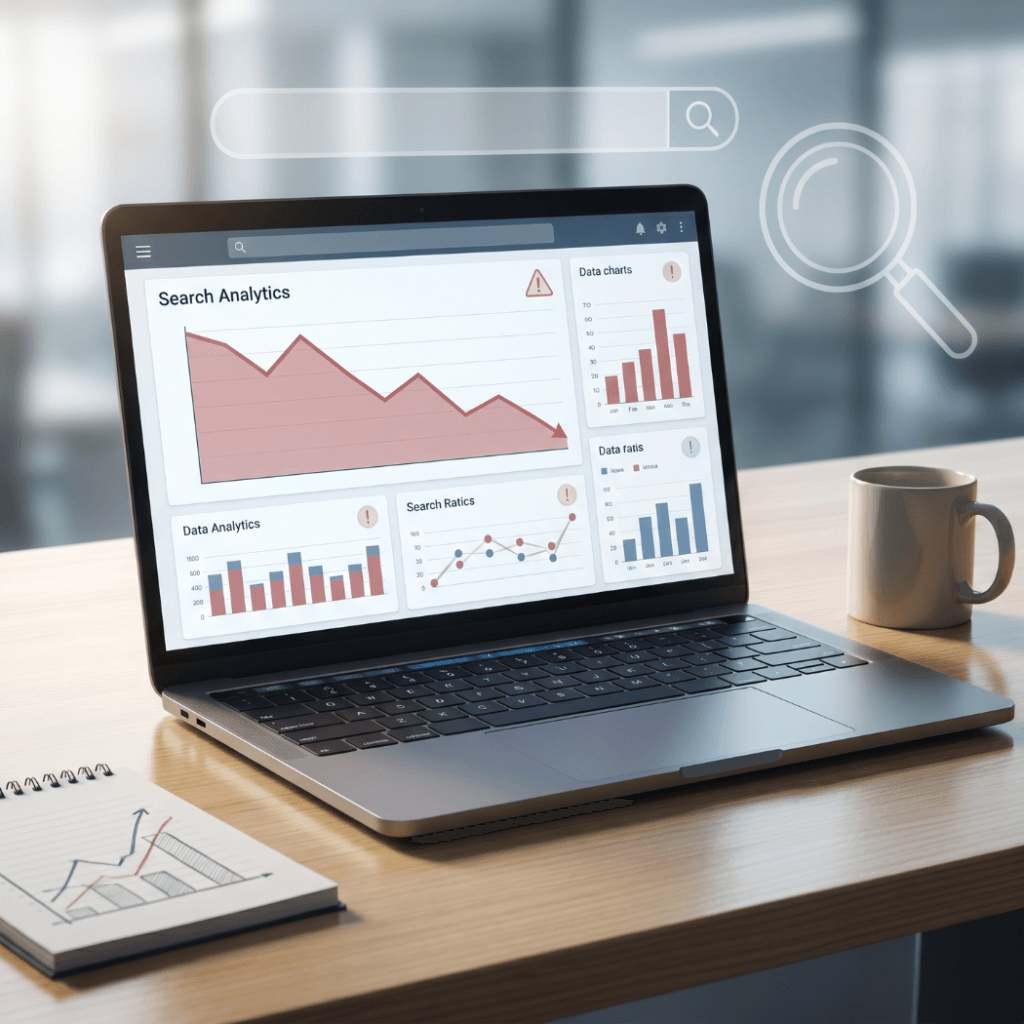
If your Google Search Console impressions dropped in 2026, you are not alone, and your clinic is probably fine. Three separate events hit GSC data this year, and each one has a different cause and a different fix. This guide breaks down all three so you can diagnose your own site and stop guessing.
TLDR: The Google Search Console impressions drop 2026 has three causes: a Google logging error that kept Search Console from reporting impressions accurately from May 13, 2025 to April 27, 2026, the May 2026 Core Update, and AI Overviews absorbing clicks. Clicks were never affected by the bug, which makes clicks your stable signal going forward. Read on to learn how to tell which cause hit your site and what to do about each one.
Important Note This article is for educational purposes only and does not constitute legal, medical, or regulatory advice. Marketing strategies discussed should be reviewed by qualified legal counsel before implementation, particularly regarding FDA, FTC, and state-specific advertising regulations. Regen Portal is a marketing and consulting company, not a law firm.
I have been in this industry since 2015, and I have never seen a spring like this one. In April and May of 2026, my inbox filled up with the same message from clinic owners. Their impressions fell off a cliff. Some thought Google penalized them. Some thought their SEO partner broke something.
Here is the truth. Most of those sites did not lose real visibility at all. Google admitted its own reporting tool had been wrong for almost a year. Then a core update landed. Then AI Overviews kept eating clicks. Three events, stacked on top of each other, in one confusing window.
By the end of this article, you will know how to separate a data correction from a real ranking loss. That difference decides whether you should change anything at all.
The Three Causes Behind the 2026 Impressions Drop
Three separate events caused the GSC impressions drop that healthcare marketers saw in 2026. One was a reporting bug, one was an algorithm update, and one is a long-term shift in how people use search. Each needs a different response.
Here is a quick comparison before we dig into each one. Search Engine Optimization (SEO) is how you make your website show up in Google search results, and GSC is the free Google tool that reports on it.
| Cause | What Happened | What It Means |
|---|---|---|
| GSC logging error | Impressions not reported accurately from May 13, 2025 to April 27, 2026 | Data problem, not a real drop |
| May 2026 Core Update | Rankings reshuffled May 21 to June 2, 2026 | Real visibility change, up or down |
| AI Overview absorption | AI answers reduce clicks on results | Real behavior change, ongoing |
What this means for your practice: a falling impressions line is not one problem. It could be a chart correction, a ranking change, or a click shift. You have to check which one before you act.
With the map in place, let’s start with the biggest surprise of the year: the bug.
Cause One: The Google Logging Error
Google confirmed on April 3, 2026 that a logging error had kept Search Console from reporting impressions accurately since May 13, 2025, and that you may see a decrease in impressions as a result. The fix rolled out through late April, and Google marked the issue resolved as of April 27, 2026. That is almost 50 weeks of impression data that read too low.
According to Google’s own data anomalies documentation, only impressions and related metrics were affected. That includes click-through rate (CTR), which is how often people click your link, and average position. Clicks were never wrong.
Think about what that means. If your impressions dropped sharply in April or May 2026 while your clicks held steady, you likely did not lose anything. The chart just got honest. Google’s fix applies going forward only. The company has said the bad historical data will not be rebuilt.
The bottom line: any impression comparison that touches the May 2025 to April 2026 window is permanently unreliable. Annotate your reports and move on.
The bug explains part of the story. The core update explains another part, and that one was real.
Cause Two: The May 2026 Core Update
The May 2026 Core Update ran from May 21 to June 2, 2026, dates logged on Google’s Search status dashboard, and it did change real rankings. It was the second broad core update of the year, following the March update that ran from March 27 to April 8. Google described it as a regular update meant to surface more helpful content from all types of sites.
A core update is a broad change to how Google ranks everything. It is not a penalty aimed at your clinic. Google reassesses which pages best serve each search, and some sites gain while others lose.
Healthcare sites need to pay extra attention here. Google holds health content to a higher bar under its YMYL standard. YMYL stands for Your Money or Your Life, and it covers topics that can affect someone’s health or finances. Some third-party trackers reported strong movement in health categories during this update, and they flagged volatility spikes around May 23 and May 30 before the rollout closed. Those are third-party measurements, not Google statements.
If your rankings and clicks fell during that window, the update likely touched your site. That is a content quality question, not a data question. My guide on why regen clinics struggle to rank covers the most common quality gaps I see.
Two causes down. The third one is quieter, and it is not going away.
Cause Three: AI Overviews Are Absorbing Clicks
AI Overviews reduce how often people click traditional search results, even when your page still appears. An AI Overview is the AI-written answer Google shows above the normal results, part of what Google documents as its AI features in Search. Your page can earn an impression there without earning a click.
The data on this is consistent. Pew Research Center studied real browsing behavior and found users clicked a traditional result in 8 percent of searches with an AI summary, versus 15 percent without one. That is nearly half the clicks gone when the summary appears. Ahrefs later measured a 58 percent CTR drop for top-ranked pages when an AI Overview shows.
Why this matters: your impressions can look normal, or even grow, while clicks shrink. That gap is not a bug. It is the new shape of search. I cover the response playbook in my post on how AI Overviews are changing clinic SEO.
Now let’s put the three causes together into a diagnosis you can run yourself.
How to Diagnose Which Cause Hit Your Site
You can diagnose your own site in about 20 minutes using clicks as the anchor metric. Clicks were never affected by the bug, so they tell the truth. Open the Performance report in Search Console and work through these steps.
- Pull clicks, not impressions, for January 2026 through today.
- Mark two dates on the chart: April 27 (bug fix complete) and May 21 to June 2 (core update).
- If impressions fell around late April but clicks stayed flat, you are looking at the bug correction.
- If clicks fell during or right after the core update window, the update touched you.
- If clicks slid slowly all year while impressions held, AI Overviews are absorbing your queries.
Google advises waiting at least a week after a core update finishes before judging impact. For the May update, that means comparing the week of May 14 to 20 against the week of June 3 to 9 or later. Google’s core updates documentation explains this clean-window rule.
What this means for your practice: most clinics I have reviewed this summer fall into the first bucket. The chart corrected, and nothing real changed. A smaller group took a genuine core update hit and needs content work.
Here is how that diagnosis could play out for a practice.
How This Looks in Practice
Consider a hypothetical regenerative medicine clinic whose impressions fall sharply between mid-May and early June 2026. The owner assumes a penalty and considers letting the marketing team go. Here is how the diagnosis might go.
The Challenge: impressions fall across several weeks, and nobody can say why.
The Approach: the team pulls clicks only. Clicks are flat through mid-May, which rules out a real loss up to that point. Then clicks dip after May 23, which points at the core update for a handful of blog posts.
The Compliance Check: the affected posts are old education pages with thin sourcing and no author credentials. The team adds a credentialed author, cites FDA sources properly, and keeps every claim inside compliant language.
The Result: the site’s reporting settles on a clicks-first baseline, and the refreshed pages are ready for reassessment in the next update cycle. No specific outcomes are promised. The point is the process: diagnose first, then fix the right thing. Note: This scenario is illustrative and does not reference any specific Regen Portal client.
That example leads straight into the metric question everyone asks next.
Clicks Are Your Stable Signal Now
Clicks should be your primary organic metric going forward, for two reasons. First, Google confirmed clicks were accurate through the entire bug window. Second, in an AI Overview world, an impression no longer means a person saw a blue link the old way.
That does not make impressions useless. They still show where you appear. But treat them as a rough visibility signal, not a performance score. Pair GSC clicks with the conversion data in your analytics, and track both against consultations booked. My breakdown of marketing analytics metrics worth watching shows the full stack I recommend for regen practices.
One more piece matters here: your baseline.
Setting a Clean Baseline for the Rest of 2026
Your clean baseline is later than it first looked. Everything before April 27 carries impressions that were not reported accurately, the May window carries update turbulence, and several later events add more noise. Here is the simple annotation plan I give clients, updated November 3, 2026 for events that came after this post first ran.
- Mark May 13, 2025 to April 27, 2026 as “impressions affected by Google logging error.”
- Mark May 21 to June 2, 2026 as “May core update rollout.”
- Mark mid-September 2025 as “num=100 removal,” when Google dropped that results parameter and many sites saw lower impressions.
- Mark June 24 to 26, 2026 and August 18 to 21, 2026 as “spam update.”
- Mark August 13 to 17, 2026 as “Google logging error,” which reduced Generative AI in Search impressions until Google restored the data on August 21.
- Mark September 24 to October 8, 2026 as “September spam update.” Google confirmed it finished on October 8.
- Treat June 9, 2026 onward as a rough base, not a clean one, because the events above still disturb it. The first stretch free of all of them starts October 9, 2026.
- Run year-over-year comparisons on clicks only until mid-2027.
Keep in mind that Google counts AI Mode activity in Search Console’s Web results, so even the clean data blends surfaces. For AI impressions on their own, use the generative-AI report in Search Console, which Google launched on June 3, 2026 and opened to all sites by August 31, 2026. It shows impressions only, with no click or query data. This is one more reason a 2026 SEO blueprint for regen clinics has to be built around clicks, conversions, and revenue rather than raw impressions.
If you want the deeper strategy work behind these numbers, that is exactly what our SEO services built for regenerative medicine handle every day. I also talk through these Google shifts regularly on the Regen Portal YouTube channel at https://www.youtube.com/@oatellez if you would rather watch than read.
FAQ
Why Did My Google Search Console Impressions Drop So Much in 2026?
Google says a logging error kept Search Console from reporting impressions accurately from May 13, 2025 to April 27, 2026, and that you may see a decrease in impressions as a result. Clicks were not affected. If your clicks held steady while impressions fell, the drop was the correction, not a real loss.
Is the Google Impressions Drop in 2026 a Bug or Real?
It can be both, which is why diagnosis matters. The late-April drop was the bug fix. Changes during May 21 to June 2 could be the core update. Check clicks first. If clicks did not move, the change was almost certainly the data correction.
Did Google Fix the Search Console Impressions Bug?
Yes, going forward. Google marked the issue resolved as of April 27, 2026. However, Google has said it will not rebuild the bad historical data, so the affected window stays distorted in your reports forever.
How Do I Read My GSC Data After the May 2026 Core Update?
Wait for a clean window, then compare. Google suggests waiting at least a week after a rollout ends. Compare the week before May 21 against the week of June 3 or later, and lean on clicks rather than impressions.
What Is the Correct Baseline for GSC Impressions After the 2026 Update?
June 9, 2026 sits past the bug fix and the core update rollout, but it is not fully clean. Spam updates in June, August and September, and a reporting error in August, still disturb impressions. The first stretch free of all of them starts October 9, 2026, after Google finished the September spam update on October 8.
Should I Panic About the Drop?
No. Panic leads to bad decisions, like rewriting pages that were never hurt. Diagnose first with clicks. Then act only on the pages that show a real click decline tied to the update window.
What Metrics Should I Rely on Now?
Clicks from GSC, conversions from your analytics, and consultations booked. Impressions become a secondary signal. Revenue per channel remains the final scorecard for any cash-pay practice.
Key Takeaways
- Three main events hit GSC in 2026: a year-long impressions logging error, the May core update, and AI Overview click absorption. Other events add noise, so annotate them too.
- The logging error kept impressions from being reported accurately from May 13, 2025 to April 27, 2026, and Google will not repair the historical data.
- Clicks were never affected, which makes clicks your most trustworthy organic metric.
- The May 2026 Core Update ran May 21 to June 2. Some third-party trackers reported strong movement in health categories, so real losses in that window need content quality work.
- AI Overviews cut traditional result clicks nearly in half when they appear, per Pew Research Center data.
- Treat June 9, 2026 as a rough starting point, not a clean base, and annotate every event listed above. The first stretch free of all of them starts October 9, 2026.
Your Next Step
PS: If your dashboard has been lying to you all year, you deserve a straight answer about what is real and what is noise. That is the kind of work we do at Regen Portal, and it starts with a conversation, not a contract. Send me a note at hello@regenportal.com and tell me what your numbers look like. And if you want ongoing plain-English breakdowns of Google’s changes, subscribe to the channel: https://www.youtube.com/@oatellez
About Regen Portal
Regen Portal is a marketing and consulting company built for the regenerative medicine industry. We handle practice consulting, marketing compliance, search engine optimization, content creation, social media management, paid advertising, website development, branding, and AI and ops consulting for clinics, manufacturers, distributors, and independent providers. For more on me and how we work, visit Regen Portal and contact us.
Oscar Tellez is the founder of Regen Portal, a marketing and consulting company built for the regenerative medicine industry. He has been in this industry since 2015. He started in medical sales and has worked with PRP since 2016. He has reached hundreds of practices and over 200 doctors through sales, teaching and marketing. He holds a B.S. in Exercise Science and Health Promotion from Florida Atlantic University.